Showing posts with label Chicken Talk. Show all posts

Saturday, April 7, 2012

Happy Easter!

Who needs to color eggs when you have chickens that do it for you?!?  We'll still be coloring so the kids can have some fun, but I absolutely love their natural colors.  Do you color your eggs or do you just enjoy their natural color?


Friday, January 20, 2012

Chick 'N Coop Giveaway!!!

Attention my chicken lovin' readers!  Here's your chance to give your chickens a complete makeover!  I wish I could say that I was the one able to give this amazing package away, but the credit here goes to Purina, The Green Chicken Coop, and GRIT!  Register HERE to win a year's supply (28 bags) of Purina Layena Plus Omega 3 poultry feed provided by Purina and the Elizabeth chicken coop from GreenChickenCoop.com.  I know how awesome it would be to win this for my girls, so I couldn't help but share the info with you fine people.  Good luck!  

Here are some of pics of our girls from a couple of weeks ago, enjoying a snack (tomatoes, lettuce & apples) in the yard on a gorgeous 50° day in Wisconsin, in January!!  Now the yard is covered with snow and we're lucky to get to 10° during the day -needless to say, the girls haven't set a pretty foot out of the warmth of their coop in days.  


The Bearded Ladies...Ameraucanas!


Miss Crooked Tail, The Welsummer


Goldie, The Easter Egger & Red, The Barred Plymouth 


 Sparkle, the big-breasted Speckled Sussex.  
Travis always says she'd make good soup-I say, not in my kitchen!


Goldie, The Easter Egger & Sparkle, bringin' up the rear!


Friday, November 18, 2011

Little One-The Leghorn Silkie

This is Little One- the big white Leghorn (A.K.A Leggern) with the largest, brightest red comb in the flock.  She came to us early this summer after being hatched at a nearby elementary school.  She was the sole survivor and needed a place to stay, so we took her in.

Anyone who has raised chickens knows how hard it can be to integrate new chickens into an existing flock, especially ONE bright white chicken in a sea of dark feathered friends or maybe I should say, enemies.

We decided our Silkies would probably accept her without trying to kill her, so that's where she went.  For the first couple of weeks, we kept her alone and then put her in with the Silkies and separated them by wire so they could get acquainted.  Once the wire was removed, all was well in the world.

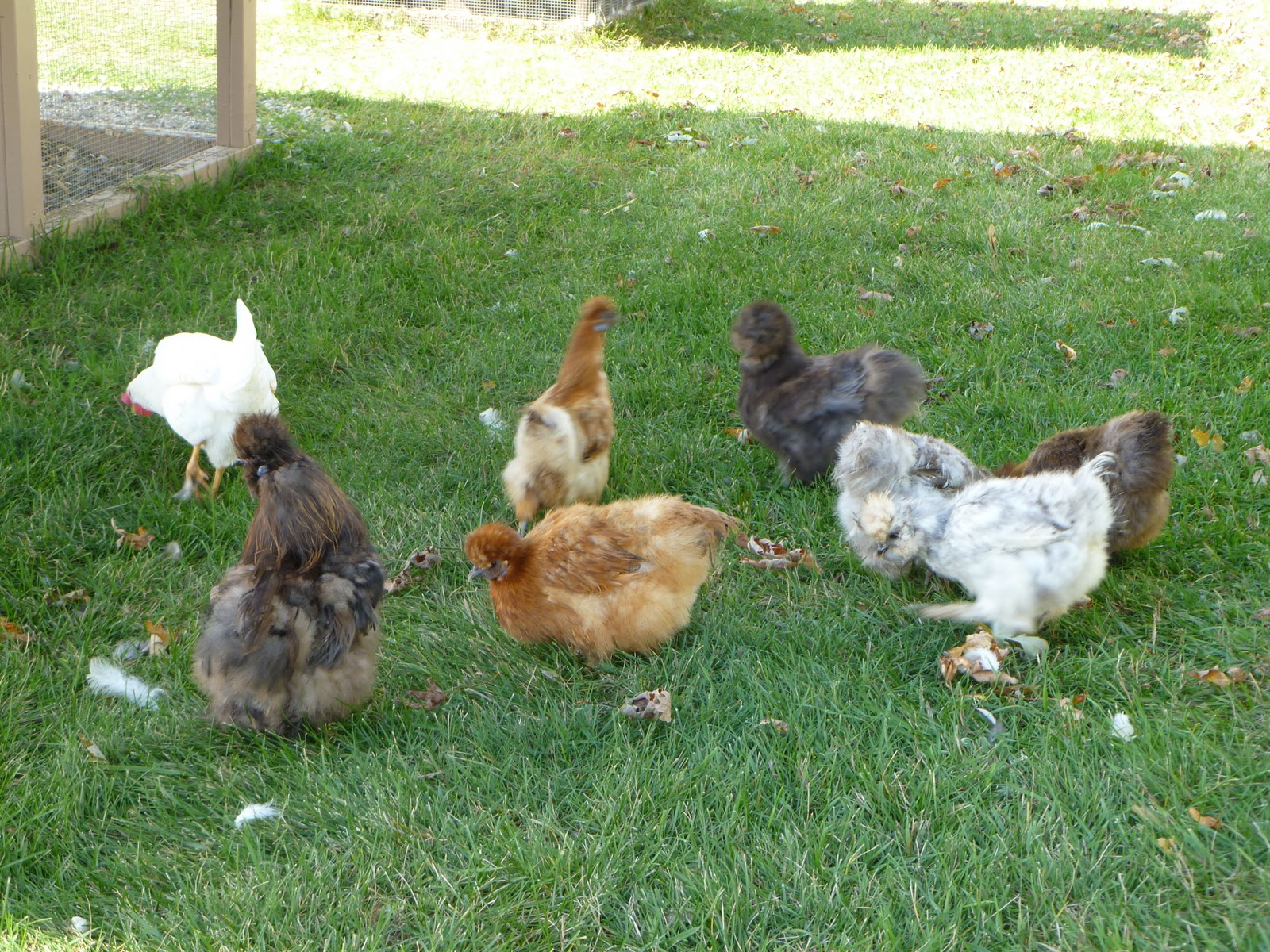
We built a separate coop for our Silkies after learning the hard way that our big girls would attempt to eat them if we put them all together...theirs is the little one on the left.


We often open the doors and let all the girls, big and small, outside to roam around.  So far, they all get along when allowed to roam together.  They do keep to their own territory though; it reminds me of tween boys and girls-all the Silkies on one side and the Big Girls on the other!

Little One did manage to make her way into the Big Girls' coop one afternoon and a beastly Ameraucana decided to attack her beautiful red comb.  She was probably jealous-women can be so difficult.  Thankfully, Travis was outside and was able to rescue her.  He brought her inside, I washed up her comb, put some antibiotic ointment on it and off she went.

Needless to say, she has never entered the Big Girls' coop again & the incident confirmed that she'd never be able to be housed with the big girls as I had hoped maybe she'd be able to do one day.  At this point, I'm sure if I were to show her her own reflection in a mirror, she'd swear it wasn't so.  I'm certain she thinks she looks just like her coop mates.  We'll just let her go on believing.


Wednesday, October 19, 2011

Chicken Poop Lip Junk!

My sister-in-law & brother-in-law brought me one of these the other day at our monthly Wiedenhoeft Sunday lunch, or dinner, as lunch is often called out in the country.  Then what is dinner, you ask?  Well, supper, of course!  I digress.

Back to the star of this show, Free Range Chicken Poop Lip Junk!  The primitive style package is cute and sure to please any chicken lover.  In fact, I haven't had the heart to open it yet.  I may just hang it on my wall in the kitchen for character or for that moment of dry lip desperation that's sure to hit once the balmy days of Wisconsin winter set in.

This gift also made me realize that I've sealed my seat in our family as that person; you know, the crazy chicken lady.  Once people start buying you random gifts related to your obsession and passing them around secretively before giving them to you-giggling all the while, I think it's a sign.  Thank you Brad & Jenny for making it official.  I digress again.  
Grandpa says: 
If ya' got dry lips
put chicken poop on 'em 
so ya' won't lick 'em.

Simone Chickenbone Natural Put-Ons, the creators of this fine chicken poo product, point out that there isn't really chicken poo or poo of any kind contained in this lip junk.  Actually, the ingredients include avocado oil, jojoba, sweet orange, lavender essential oil, bees wax & vitamin E.  Sounds yummy.  All of their products are made with natural ingredients & are earth-friendly too...bonus!  

As the winter rolls by and my lips start to crack, I'll let y'all know if this junk really works!  

By the way, I've missed y'all and promise to pay more attention to you.  I swear.


Saturday, August 6, 2011

Bug Control

Wow, where has the time gone?  While I've been making mental notations for future posts almost daily, it's been over a month since I've checked in!  I'm hoping y'all have been as busy and I have this spring/summer and haven't noticed my lengthy hiatus.  Since I've been gone so long, I figured I had better bring some stupendous information your way to keep you coming back!

My seasoned chicken keepers out there are probably familiar with Diatomaceous Earth (DE), but I've come across so many folks who haven't heard of it that I reckon it doesn't hurt to touch on this incredible creation that needs to be a part of any chicken lovers arsenal.  Gardeners, listen up, 'cause it's also proven to be a wonderful addition to any garden shed!    First things first, how the heck is diatomaceous pronounced?  Click here, thanks to Merriam-Webster, you'll never have to wonder again.

Diatomaceous Earth (DE) is 100% natural, safe & non-toxic.  It's a fine, white powder derived from the fossilized remains of diatoms, a type of algae.  Food grade DE can be used to prevent mites & lice in your flock as well as internal parasites.  Add DE to nest & dust boxes, coop bedding, the run, sprinkle around the coop as a barrier, or apply directly to birds (under wings & around vent) if you're experiencing an infestation. Add 1 pound of DE to 50 pounds of feed to help prevent internal parasites.  You can also mix DE with water to form a slurry paint that can be brushed on roosts and other surfaces.  Gardeners, use a shaker can to sprinkle throughout your garden to help control the bugs that enjoy annihilating your fruits & veggies!

How does it work, you ask?  DE has microscopic, razor sharp edges that are harmless to humans & other large animals (chickens, dogs, cats, etc...) but are deadly to small insects.  The sharp edges cut through the insect's protective covering, drying them out and ultimately sending them to bug heaven.  If ingested, it shreds their insides.  DE is an incredible alternative to some of the synthetic insecticides on the market that kill by attacking the nervous system and require more precaution when being applied.  Will you get the same control you would get using a synthetic? Probably not, but many synthetics are no longer labeled for use around animals and food.

The best place to purchase DE is from a local feed mill, farm cooperative or garden center.  I've seen 5LB bags online for more than what a 40LB bag costs at the farm co-op.  If you live in my  neck of the woods, I just happen to work at a farm co-op and can order 40LB bags that retail for $23!  One bag goes a long way, so start with one & see how it works for you and your 2-legged friends!

Saturday, July 2, 2011

Butter & Chickens!

I love Paula Deen, she's butter fearless AND loves chickens.  Check out her coop, I thought our chickens were spoiled!  The best part, she rescued her girls and they all look healthy and happy!  I wish she was my neighbor.


Paula's Chicken Coop from Paula Deen on Vimeo.

Tuesday, June 7, 2011

Layena Plus Omega-3 Video

Learn more about the Purina 60 Day See The Difference Challenge & sign up for coupons here

Wednesday, June 1, 2011

New Grub

Today I was reading up on chicken rations and found some info about flaxseed and how it aids in increasing the presence of Omega-3 fatty acids in eggs.  

Omega-3 fatty acids are necessary for our health, however, our bodies can't make them.  We have to get them from our food or from supplements. Omega-3's are found in some plants, nut oils, and fish, such as salmon, tuna, and halibut. Omega-3 fatty acids play an important role in brain function and normal growth & development.

The materials I came across also indicated that flax is beneficial to the health of the hens in addition to providing enhanced nutrients in their eggs.  I then began to wonder if it would be best to supplement flax in our scratch mix or to find a layer ration that has flax in it.  After discussing it with our Lifestyles Feed Specialist, Lynette, it turns out that whole flax is hard for any animal to digest so it would be more beneficial to the animal if it were ground into the feed.  Our discussion proved to have an added bonus because she turned me on to Purina's Layena Plus Omega3 layer feed.  Needless to say, I ordered some to stock at our store for myself and for others who may be interested in a feed that offers more than the current feed they are using.  The cost is only going to be about $1.50 more per bag and I feel it's well worth it! 

Here are just a few of the features and benefits of this product taken from Purina's website:
Formulated to produce 200mg Omega-3 per large egg providing 300% more Omega-3 than a typical egg!

Natural vegetarian formula without added antibiotics or hormones

Peace-of-mind – feed your birds like you feed your family

Superior Nutrition for strong healthy birds that lay plenty of wholesome eggs

Select level of marigold extract for rich golden yolks

Key levels of calcium and manganese for strong shells with fewer cracks
Optimized level of Vitamin E to support a healthy immune system


Has anyone out there tried this feed already?  If so, what are your thoughts?  If you haven't tried this feed, have you tried flax in your feed rations?  What has your experience been?


Tuesday, May 17, 2011

Hosta Time!

Turns out, our girls fancy hostas!  They continue to enjoy their time in the yard these days.  On a side note, I've realized, once again, that flip flops are not an option when visiting with the girls during the spring and summer months.  I think this may be a lesson I learn on an annual basis!  I should have read Backyard Tip #1 before the weather improved to remind myself!  I took some pictures while out visiting the girls today.  The weather is wonderful and all the trees and flowers are starting to bloom...finally.  Enjoy!

Girls snacking on hostas in the rear while a nosey, molting Welsummer and an Ameraucana check out the camera!


Poor hostas...


Flowering crabapple tree...the prettiest tree in our yard.  It reminds me of Trav's grandma Rose who passed away recently.  It's nice to have something so beautiful to remember her by.


Munching on leftover sweet corn from last night's dinner!  Who needs a garbage disposal?!?!?


This Ameraucana is enjoying a warm sun bath!


Sunday, May 15, 2011

RIP Gimpy

Sadly, Gimpy's condition worsened over the last week and Travis had to put her down yesterday.  I know some of you were wondering about her.  I always cry when we lose a chicken.  Although some may find that strange, they are like our pets.  She wasn't eating anymore and she was getting worse daily.  While we were never able to figure out what exactly was wrong, we decided it was best to relieve her of any pain/suffering she had been enduring. 

Friday, May 6, 2011

Chicken Chatter

Our girls are chompin' at the bit every day when we get home; they can't wait to get out in the yard and free-range for a few hours.  I love watching them do what chickens do.  Scratching, finding bugs and other treats, chasing cats and each other, pretending they are eagles-wings spread, running across the soft green grass, occasionally leaving the ground- snacking on the neighbors flowers, checking on the progress in the garden & chattering away like they are all having their hair (or feathers) fixed at the beauty salon!  I also adore how they follow us around as if we have treats comin' out our heels!  This cartoon reminded me of our spoiled little girls-Oh, what a life...

Tuesday, May 3, 2011

Gimpy Goes to the Hospital

I'm starting to feel like I should be some sort of chicken doctor.  About a month ago, I had to isolate one of my Silkies because she got injured somehow, maybe by an overzealous roo, but I'm not really sure.  For safety sake & knowing that Elvis was a bit aggressive with the girls, the suspect roo has since been donated to our friends at The Gee Funny Farm.  Besides, Brooke was never very pleased about having another man around the coop! 

Anyhow, after a week of not getting up (she'd just fall to her side and lay there), I figured it would take a miracle for her to survive.  However, as long as she was eating, drinking and dropping, I refused to cull her.  I had food and water within neck reach and a heat lamp on her to warm her up!  A week and a half into her treatment, I was thrilled to find her standing and peaking her head up and out of her hospital bed!  Miracle is now back with the rest of the Silkie bunch, happy as ever.

Currently, Gimpy, one of our Silver-laced Wyandottes has a similar leg problem.  They've never been housed together, so I know it's nothing more than a coincidence.  She began limping around, then got to the point where she'd only hop on her one leg, now, she doesn't move much at all.  I decided I better remove her from the coop and give her the same treatment Miracle received.  While trying to feel around that leg today, I did feel & hear a POP!  I'm just praying it was a good pop.  We suspect Miss Gimpy either dislocated something or has nerve damage of some sort.  Her leg is limp and she doesn't move her toes at all.  I suppose time will tell if she'll recover or not.  At least for now she is warm and within necks reach of food and water. 

Eating and drinking is always a good sign!


She doesn't seem to mind being on bed rest!


A plastic tub large enough for her, but small enough to keep her from trying to move around too much makes for the perfect chicken hospital bed! 


Friday, April 29, 2011

Spring Peepers!

As some of you know, I work at a farm cooperative.  Today, our first order of 25 Hobby Farm Assorted chicks arrived (Jumbo Broilers, Special Blacks & Browns from Sunnyside Hatchery).   One of the chicks didn't make the trip, but the rest were peppy and chirping away.  I love having chicks in the office, particularly when little children come through.  I get to show them off and the kids get so excited at the chance to pet a chick!  Many of the adults that swing through aren't as enthused; they are more curious about how I tolerate the chirping for the day.  Hearing these guys & gals doesn't bother me at all, as a matter of fact, these cute little critters made me want to order more for myself.  I've resisted the temptation-at least for now!

Thursday, March 31, 2011

Silkie Fever

Even the stars have Silkie fever.  Here's a photo of Tori Spelling and her gorgeous white Silkie, Coco.  How precious.  Honestly, I was thinking it would be nice if Coco were to drop a big, stinky chicken load on her, but maybe she's so rich she can have someone fashion chicken Depends for her birds.  Seriously, props to Tori n' Dean if they're sincerely goin' Cali-farmer.  As the article reads, she was out walking her family goat a few weeks ago.  I just hope this isn't the next big fad after which the animal shelters will be spilling over with chickens rather than chihuahuas.  All I've gotta' say is if Paris Hilton shows up with a Silkie, I'm gonna' puke...for days. 

Wednesday, March 30, 2011

Chickens & Cats Form Peace Treaty

Anyone who lives in the country knows someone with ALOT of cats and most likely ALOT of chickens!  My neighbor, who happens to be my dear Mother-in-law, is the cat lady and I'm the chicken lady.  At first I was concerned her cats would eat my girls until I saw a chicken charging a cat as the cat ran frantically for its life.  Since they've had time to get acquainted, it seems the chickens and cats have formed a peace treaty of their own.  I think it goes something like, "Hey, if you don't peck me, I won't shred you to bits with my claws!"  Our girls even share their treats with the cats!

Here's Red and one of the scavenger neighbors on the prowl for treats!


It's always a challenge keeping the cats out of our yard and the chickens out of the neighbor's yard, so, for now, we've come to an agreement as well...until one of us figures out how to keep our livestock out of the other's yard, we're just gonna' deal with it!  I'm not certain how long this will last as my Mom-in-law's garden and flower beds are sure to be irresistible targets for our happy hens!  They'd have the garden obliterated before the Duke boys could get outta' Hazzard in The General Lee!  I'll post pics of that later...ha!    

Friday, March 25, 2011

Broody, The Easter Egger

I saw this cartoon and it made me think of our Easter Egger, who now carries the name Broody

Broody has decided that she wants to do nothing more than sit in the nesting box, day and night, with the hopes of hatching her eggs and any other egg that may be lying in wait.  Since we're not in the business to turn out eggs at rapid speeds, we've humored her diligent desire to spend hours on end attempting to bring to fruition this impossible task.  I have explained that the absence of a roo in the coop will keep her from ever succeeding since none of these eggs she's trying so hard to hatch are fertilized; however, I'm convinced that she's convinced she can do this! 

For now, we're watching to be sure she's eating and drinking as broody hens will often not leave the nest unless they absolutely must.  We've also made it a point to pull her from the nest and set her outside to free range with the others throughout the day, but she doesn't last long before high-tailin' it back to her nest to continue egg duty (eggs or no eggs).  We collect the eggs often, so she moves from nest to nest, sitting on any egg she can find until we come and take it from her.  Thankfully, she has yet to peck me as I pull her out or steal her egg.  She does let me know with her low clucks and raised feathers that she's not happy about being pestered.  I'm hoping that she'll eventually come to terms with the fact that hatching eggs is not in the stars for her, otherwise, I may have to call in a chicken whisperer to explain things for her!

Thursday, March 17, 2011

Labels, Labels, Labels!

You may have noticed that there are more options at the local grocery for eggs these days...  Regular (conventional) eggs, Cage-Free eggs, Free Range eggs, Organic eggs & Vegetarian eggs.  Have you ever wondered what all these labels really mean?  I aim to satisfy the inquiring mind, so here's the skinny on all those labels...

Conventional
These are the eggs that most consumers are purchasing.  They cost roughly $1.00-1.50/dozen and come in more generic packaging (no specialty labeling).  Many of the hens laying these eggs are given less space than a standard-sized sheet of notebook paper to live in and are often caged in battery cages.  There’s not even enough room to spread their wings.  Thankfully, after much public opposition, many egg-producers are moving from battery-cage systems to cage-free systems.


Cage Free
As stated, these hens are able to move about without being confined to cages. A significant improvement when compared to the confines of a battery cage; however, the absence of cages doesn’t always ensure high levels of welfare.  Cage free hens are often subject to crowded spaces (hens are housed together by the thousands), trimmed beaks (beaks are partially burned off to prevent pecking), no outdoor access, and early slaughter (slaughtered at approx. 2 years of age, less than ½ their normal lifespan).  There is no doubt that these hens live a less cruel life than caged hens; at the very least, they have the ability to spread their wings, lay eggs in nests and run about.  While I feel producers should do all they can to provide the best possible environment for their hens, to be fair, I must say that it would be near impossible for large producers to allow more luxuries than a cage-free system provides while continuing to supply the demand and sell eggs at a price most consumers are willing to pay.    


Free Range
This label gives the buyer a vision of chickens roaming freely on the green pastures of a rural farm.  Unfortunately, Free Range is an unregulated term and can be used by anyone.  All you need is a door that allows access to an outdoor area.  The size of that outdoor area could virtually be the size of a battery cage.  The only way to know that your eggs are laid by Free Range hens is to purchase them from a producer whose production standards can be verified or to raise them yourself.


Organic
Organic eggs come from hens that were fed an organic diet.  Again, it is my belief, that the only way you’ll be absolutely sure your eggs (or any food labeled organic for that matter) are truly organic is to purchase them from a producer whose practices can be verified or to raise organic hens/eggs yourself (which would include organically growing the feed that they eat).  Unfortunately, some of the food items the USDA considers to be organic are questionable.  For example, artificial sweeteners like, Neotame, are among the ingredients approved for organic food processing on the USDA’s list of “Certified Organic” food items.  Not sure when “artificial” became the new “organic”, but that’s just me.  By the way, I am not a die-hard organic food buyer, eater, grower, etc…nor are my hens fed an organic diet.


Vegetarian
These hens are fed a vegetarian diet (i.e. no animal fat proteins, meats, etc…). Let me point out that chickens are omnivores by nature, not vegetarians, and, if allowed, will eat bugs, grubs, worms, etc... If hens have access to the outdoors (which I feel is very important for the health and happiness of the hen), the chances of the eggs actually coming from a vegetarian chicken are slim to none.  So, if you want to ensure you’re eating eggs from girls that have seen the grass and mud of the Earth beneath their feet, Vegetarian labeled eggs are not for you.

Friday, March 11, 2011

What In Tarnation Is That?!?

I've often wondered what a hen thinks upon the arrival of her first egg.  Somehow, these girls must know what's going on... just as a woman knows when her first baby is going to arrive. 

It's really incredible how they know what the nesting boxes are for; they start laying eggs there right from the start.  And, they rarely mess in the nesting box which is a small miracle in and of itself considering the lack of concern for where they drop a load anywhere else!

The entire process, from the formation of the egg to the brooding process to the synchronized hatching of her clutch to mothering her chicks, is truly amazing!  The mother hen even communicates with the embryos while in the shell to ensure they develop and hatch at the same time.  This communication allows her to know who needs more or less heat to speed up or slow down their development.  She'll move those who need more heat to the inside and those who need less to the outside, often making changes several times a day. 

After learning all I have about chickens, I must say, I'd be honored to be called a chicken brain.  They are interesting, intelligent creatures that don't get the credit they deserve.  Give it up to the Mother Hen...   

*This is not one of our hens*

Tuesday, March 8, 2011

The Molt

Why do my hens look like Charlie Sheen after a weekend bender?  ...And, where the heck are all their feathers going?!?!?

I began wondering if our happy hens were sick, had a parasite problem, were missing something vital from their diet, etc...  At first only a couple girls were missing feathers and I suspected that they were being picked on by the H.C.I.C.'s of our flock.  However, once some of the girls at the top of the pecking order started looking just like those at the bottom, I began frantically researching for an answer.  After being in borderline obsessive research mode for awhile, I realized we were facing our first molt.  Because of their young age and the fact that they are still laying well, I believe our girls are experiencing a partial head/neck/tail feather molt. 

To give the girls some added energy and the boost of protein they'll need to replenish the feathers they've shed, we've added some soybean meal to their regular layer ration as well as a free-choice tub of Armour lard for them to enjoy.

Here's some helpful, accurate information I found on PoultryPassion.com about molting.      
Molt

Each year chickens molt, or lose the older feathers, and grow new ones. Most hens stop producing eggs until after the molt is completed. The rate of lay for some hens may not be affected, but their molting time is longer. Hens referred to as “late molters” will lay for 12 to 14 months before molting, while others, referred to as “early molters,” may begin to molt after only a few months in production. Late molters are generally the better laying hens and will have a more ragged and tattered covering of feathers. The early molters are generally poorer layers and have a smoother, better-groomed appearance.
Early molters drop only a few feathers at a time and may take as long as four to six months to complete the molt. Early molters are usually poor producers in a flock. Late molting hens will produce longer before molting and will shed the feathers quicker (two to three months). The advantage of late molters is that the loss of feathers and their replacement takes place at the same time. This enables the hen to return to full production sooner.
The order in which birds lose their feathers is fairly definite. The feathers are lost from the head first, followed in order by those on the neck, breast, body, wings, and tail. A definite order of molting is also seen within each molting section, such as the loss of primary flight feathers before secondary flight feathers on the wings.
The primary wing feathers determine whether a hen is an early or late molter. These large, stiff flight feathers are observed on the outer part of each wing when the wing is spread. Usually 10 primary feathers on each wing are separated from the smaller secondary feathers by a short axial feather.
Molting birds lose the primary feathers in regular order, beginning with the feather nearest the axial feather and progressing to the outer wing-tip feathers. Late molting hens will lose primary feathers in groups of two or more feathers, whereas early molters lose feathers individually. Replacement feathers begin to grow shortly after the old feathers are shed. Late molting birds can be distinguished by groups of replacement feathers showing similar stages of growth.
Estimating Duration of Molt
The time a bird has been molting can be determined by examination of the large primary wing feathers. Length of molt can be estimated by allowing six weeks for the first mature group of primaries and two weeks for each additional feather or group of feathers. If the primary feathers are not fully grown, the time of molt can be estimated based on the feathers’ present stage of growth.
A primary feather reaches half its full length after two weeks, two-thirds its growth after three weeks, and completes its growth six weeks after the old primary is lost. The growth rate of the replacement feathers is the same for both early and late molting hens.
Often pullets undergo a partial molt, involving the neck and tail feathers. This condition can usually be eliminated by purchasing pullets hatched in April or later in each year and by following proper management practices. The length and incidence of a molt are influenced considerably by the bird’s body weight, physical condition and environmental conditions such as nutrition and management.

Tuesday, March 1, 2011